






The future of customer service: why this time really is different
Think back to the last support call that started with "For your account balance, press 1". Or the chatbot that offered the same three buttons whatever you asked. Every new technology promised better customer service, and customers kept ending up in the same place: in a queue, in a menu with no real way out, repeating the same details.
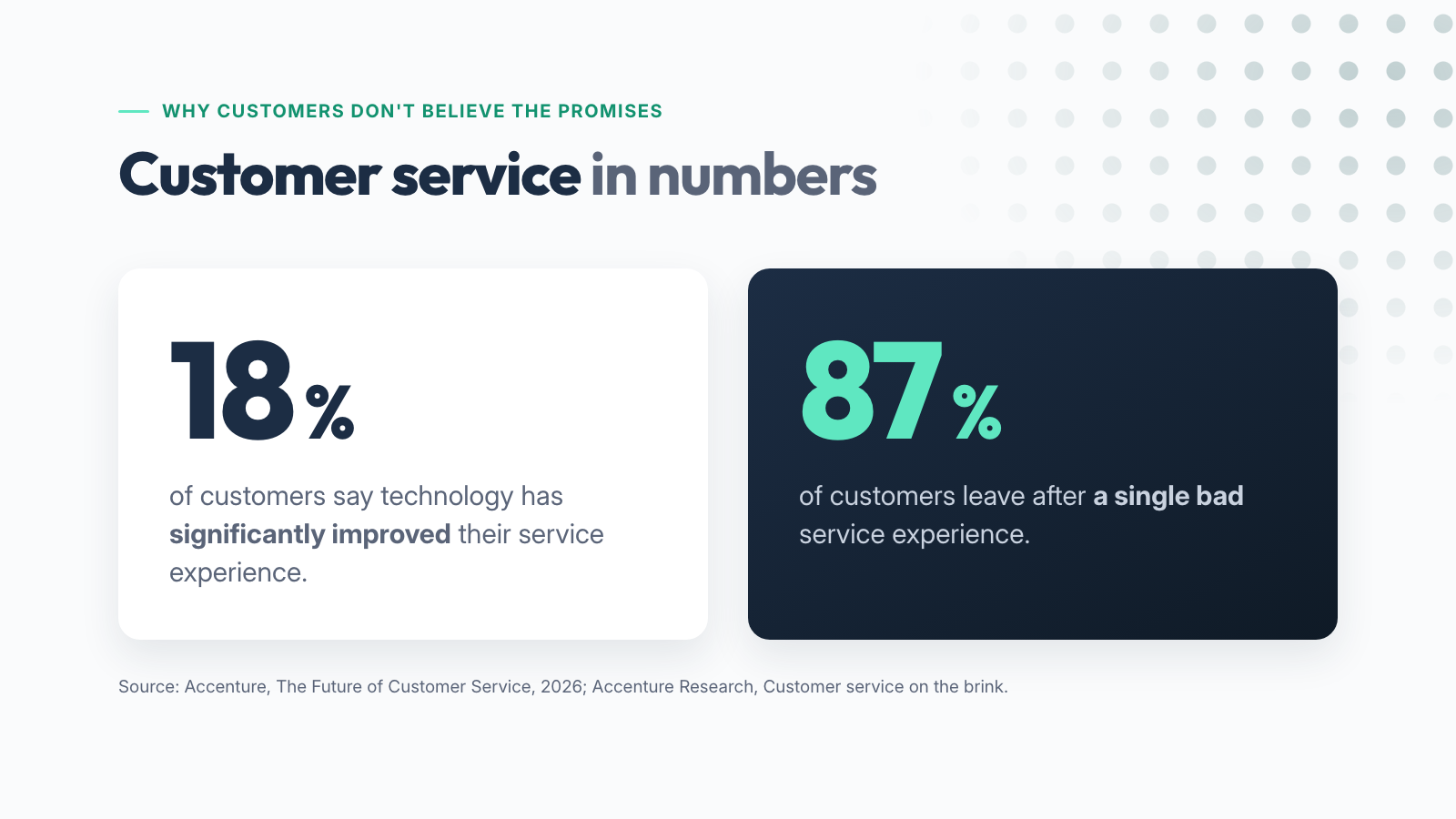
The numbers confirm it. According to Accenture's analysis The Future of Customer Service (October 2026), only 18% of customers say technology has significantly improved their service experience. At the same time, 87% of customers say a single bad service experience is enough to make them leave a brand entirely (Accenture Research, Customer service on the brink).
So why would this time be different? Because what AI can do in a conversation has changed. At 2Mobile we see it every day, in projects with Slovenian companies.
Conversational AI is more than a chatbot
When people hear "conversational AI", most picture a chat window in the corner of a website. Today it takes several forms that work together:
- An AI assistant in chat on the website and in the app, answering from your knowledge base and completing real tasks through integrations.
- Conversational messaging on Viber, WhatsApp and SMS, where the customer replies, confirms or chooses without leaving the chat.
- A voice AI assistant that talks on the phone in natural language and replaces the "press 1" menu.
- Conversational ads, where the conversation starts inside an online ad. That's how T-2, with a solution by PROSECCO 37 d.o.o., placed its AI assistant Titina right in the ad space.
- An AI co-pilot for agents that summarises the conversation, suggests a reply and saves the agent time.
- Customers' own AI agents, shopping and handling tasks on people's behalf. We wrote about this in When an AI agent shops instead of the customer.
They share one thing: the customer reaches a solution through a conversation, not a search. Below are five shifts that make it work this time.
1. From answering to resolving
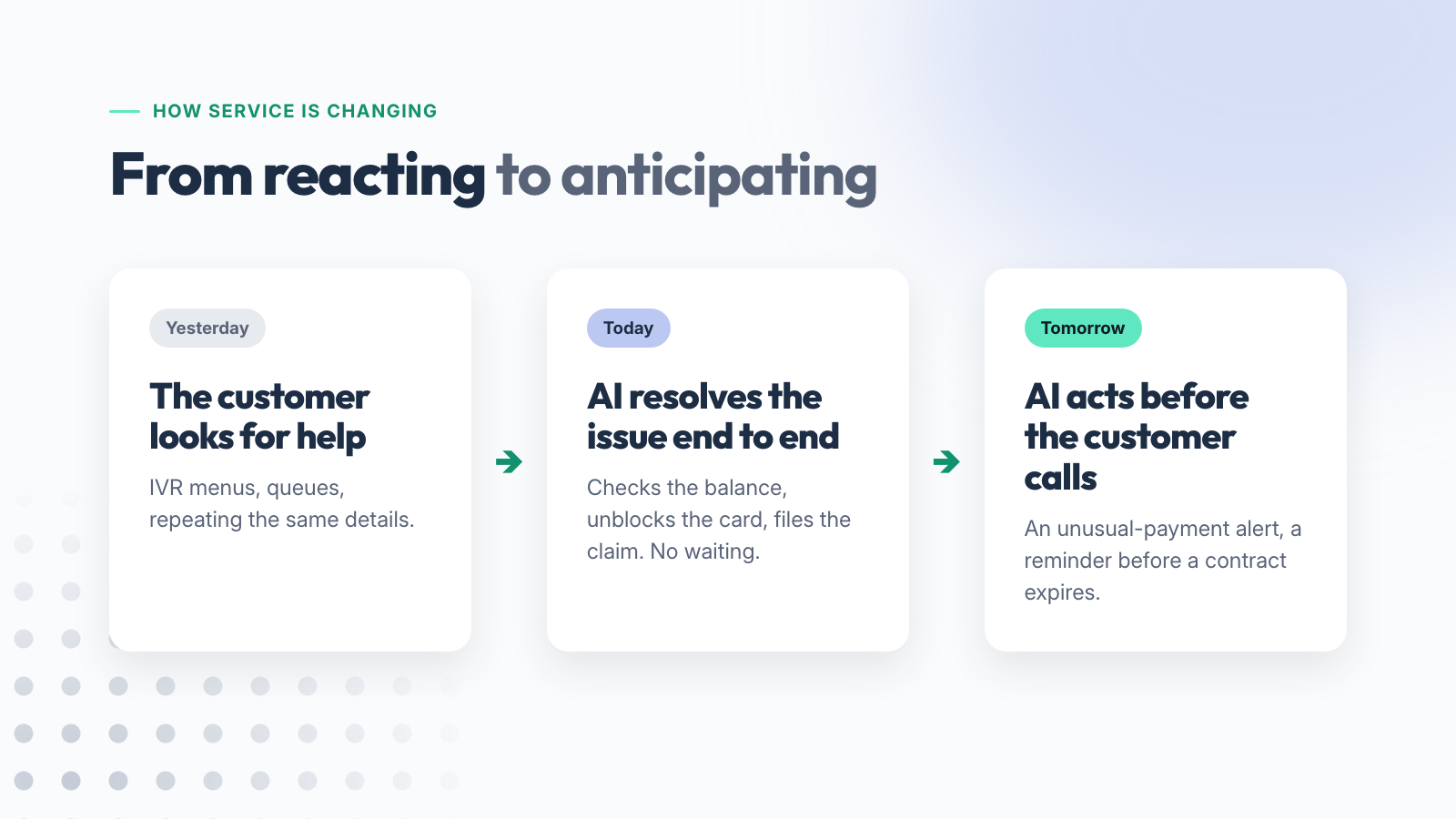
The first generation of chatbots could answer frequently asked questions. Today's AI assistant on the boost.ai platform goes a step further: through secure connections to your systems (API and action hooks) it checks an account balance, unblocks a card, changes a subscription plan or files a claim. The customer doesn't get instructions on how to do something. They get it done.
The next step is service that acts before the customer calls: an unusual-payment alert with a button to confirm it, a reminder before a contract expires, an outage message with an estimate of when service will be back. On Viber, by SMS or in the app, wherever the customer is.
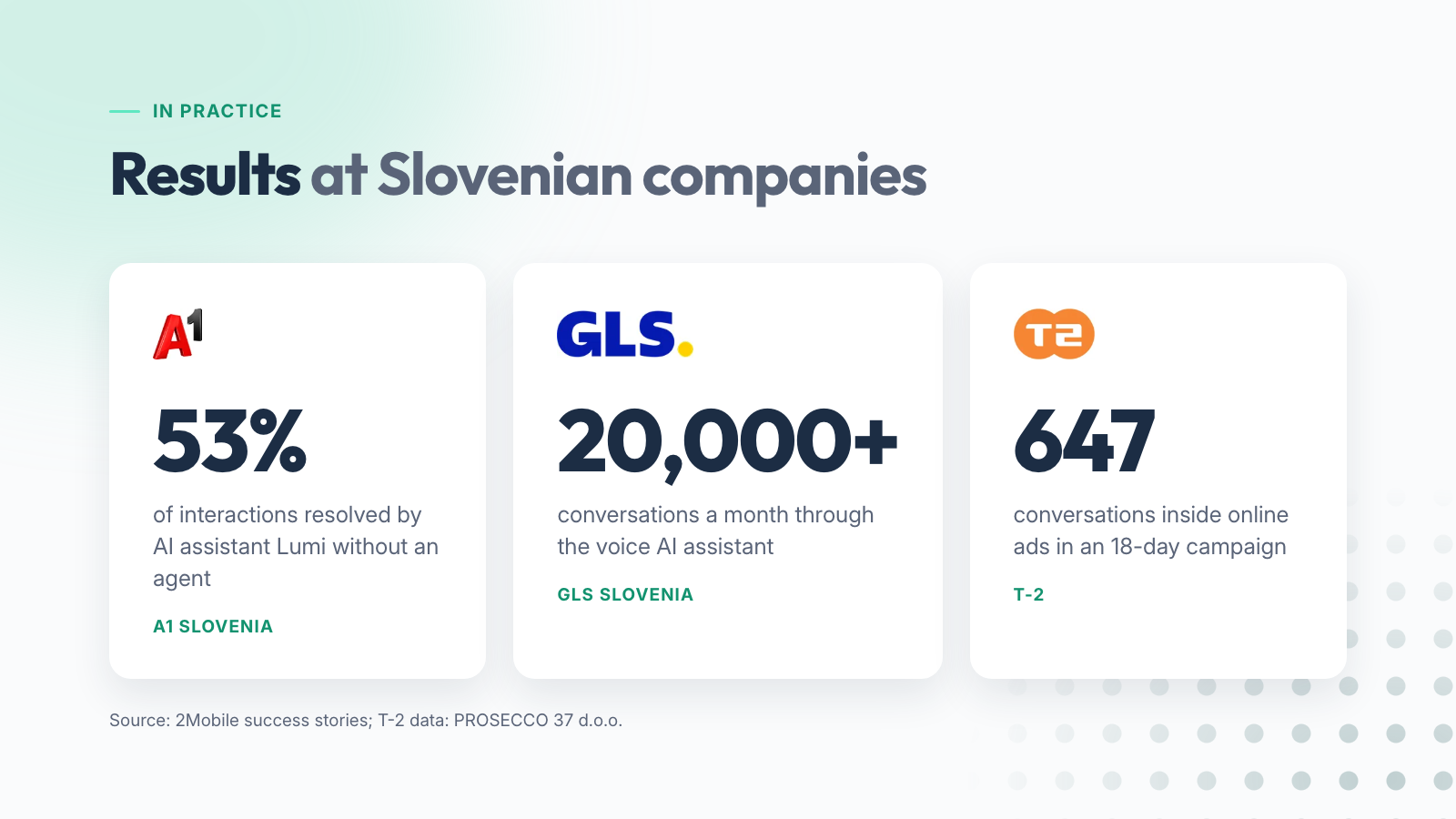
In practice: GLS Slovenia handles more than 20,000 conversations a month through its voice AI assistant, and 50% of requests are resolved without an agent. In chat, across all channels, the figure is 80%.
2. A conversation that remembers
Nothing annoys a customer more than a question they have already answered. Modern service has a shared memory: when a conversation moves from chat to a call or to a human agent, the full context goes with it. Before taking over, the agent in Human Chat sees a summary prepared by a language model and continues where the assistant left off. No repeated questions.
That continuity is what builds trust. The customer no longer experiences separate contacts with different departments, but one conversation with a brand that knows them.
3. People for the moments that matter
AI doesn't replace people in customer service. It changes what they spend their time on. The assistant handles routine questions, and agents get time for complex cases, for conversations that need empathy and judgement, and for customers who are about to leave.
In practice: A1 Slovenia's AI assistant Lumi resolves 53% of interactions without an agent. For conversations Lumi handles on her own, NPS is 113 points higher, and there are 70% fewer cases that need a human.
4. When the customer arrives with their own AI agent
A shift worth watching (we covered it in When an AI agent shops instead of the customer): customers increasingly use their own AI assistants to compare offers, file complaints and manage subscriptions. For companies, this means their services have to be understandable to machines too: clear terms, structured data, verifiable processes and APIs through which a task can be completed securely.
Companies that already have their knowledge connected in one base (a knowledge connector) and their processes open through secure connections are ready for this step. Others will have to catch up fast.
5. Service as a growth engine, not a cost
For too long, customer service has been measured only by what it costs. Good service keeps customers, builds loyalty and opens room for sales: the right package at the right moment, an upgrade while solving a problem, an offer the customer actually wants.
In practice: T-2 placed its AI assistant Titina directly inside online ads. The conversational ads functionality was developed by PROSECCO 37 d.o.o. People talk to her right in the ad: they ask about services, get technical help or check whether fibre is available at their address. Over an 18-day campaign the ads reached 2,800,671 impressions and started 647 conversations. Scenarios that addressed a specific problem performed best: "Is my WiFi secure?" reached 0.37% engagement, well above generic messages (data source: PROSECCO 37 d.o.o.). Here a conversation is a clear signal of intent, not just a click.
How to start: four steps
- Find where customers get stuck today. The most frequent questions, the longest queues, the channels with the most repeat contacts.
- Start with one clear use case with a measurable goal, such as the share of conversations resolved without an agent, or NPS.
- Connect knowledge and systems. Existing content (web, documents, databases) and processes through APIs, with guardrails set per topic.
- Measure and build on it. From chat to voice, from answering to proactive messages, in line with GDPR and the EU AI Act.
This time really is different
The difference isn't that AI is "smarter". It's that it can finally finish the job, remember the conversation and give people time back for customers. Companies that design their service this way won't just cut costs. They'll create an experience customers come back for.
That is exactly what we help companies do at 2Mobile, as an official boost.ai and Rakuten Viber partner, with experience from projects for A1, GLS, T-2 and others. Conversations start with us.
Source: Luke Mills, Accenture Song,
The Future of Customer Service, October 2026; Accenture Research, Customer service on the brink. Results in practice are from 2Mobile success stories; T-2 conversational ads campaign data: PROSECCO 37 d.o.o.